Most business owners in Greenville do not think about their roof until something goes wrong. That is understandable; there is a lot more to run. But a commercial roof in Greenville takes consistent abuse from heat, humidity, and storm activity, and the gap between “fine” and “failing” closes faster than most people expect. Having the right commercial roofing company servicing your property makes a difference in how your business is protected.
Most property owners are not commercial roofing experts, nor should they have to be. Understanding what commercial services include and how those services fit together helps property owners make informed decisions, avoid unnecessary costs, and get more life out of their roofing systems.
Why Commercial Roofing Is Different from Residential
Commercial roofing systems are built and maintained differently from residential home systems. The materials are different, the failure points are different, and the consequences of ignoring a problem are larger. A residential leak might ruin drywall. A commercial failure can interrupt operations, expose inventory, or trigger liability exposure for tenants below the damaged area.
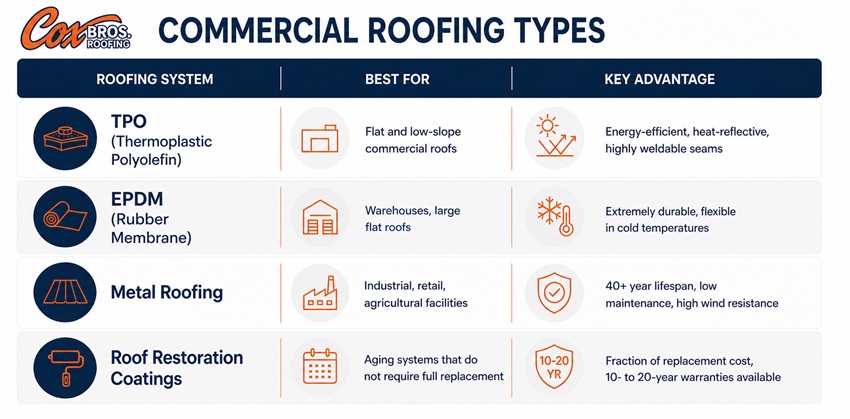
Most commercial buildings in Greenville use low-slope or flat roofing systems. The most common are TPO, EPDM, and standing seam metal. Each has a different performance profile, a different maintenance schedule, and a different expected lifespan.
That lifespan assumes the system was installed correctly and maintained on a schedule. A well-designed roofing system that gets ignored fails early. Most premature commercial roof failures we see come down to deferred maintenance, not defective materials.
What Makes Greenville’s Climate Hard on Commercial Roofs
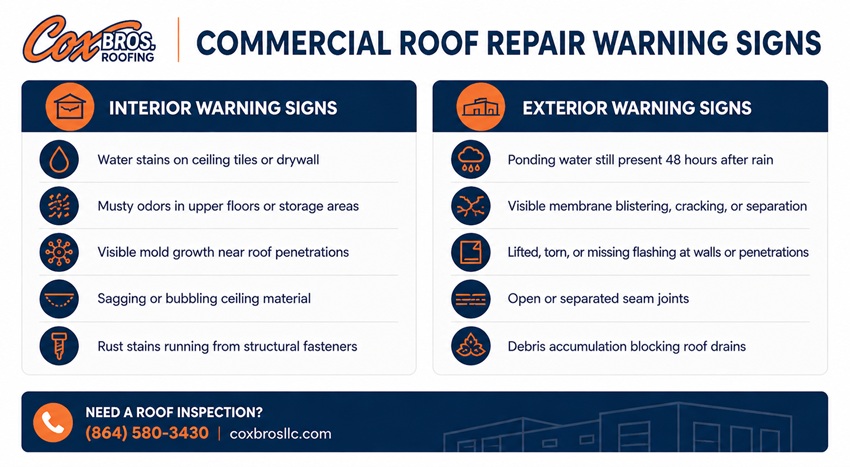
The Upstate climate puts specific pressure on roofing systems. Summer heat drives thermal expansion and contraction across the membrane surface, stressing seams and flashing over time. Greenville County sees significant storm activity from spring through early fall, and flat or low-slope roofs that do not drain properly hold standing water, which accelerates membrane degradation and increases leak risk at every penetration point.
The humidity compounds all of it. Moisture that gets beneath a membrane will not dry out on its own. It works on the roof deck and the insulation board below, and by the time it shows up as a visible problem inside the building, the underlying damage has usually been developing for some time.
The Three Commercial Roofing Situations Business Owners Face
Most of the calls we get from Greenville commercial property owners fall into one of three situations. Knowing which one you are in changes what you should be doing next.
Situation 1: You Have a Specific Problem Right Now
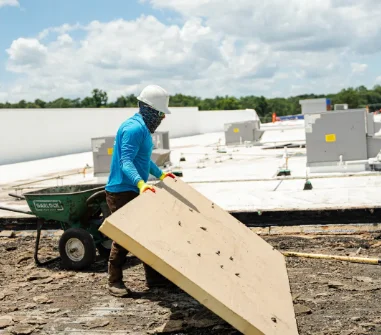
A leak, a failed seam, damaged flashing, or water intrusion after a storm. This is a repair situation, not a replacement conversation, in most cases. The goal is to identify the source accurately, stop the water entry, and assess whether the damage around the failure point has spread beyond the immediate repair area.
This is where contractor selection matters most. A misdiagnosed leak repair does not solve anything. Before any commercial roof repairs begin, make sure you have found the right roofing contractor.
Situation 2: Your Roof Is Aging, and You Are Watching It
You know the roof has years on it. You have had some repairs. You are not sure whether you are in maintenance mode or approaching replacement territory. This is another common position we see, and it is the one where a thorough inspection does the most work.
A professional inspection on an aging commercial system looks at membrane condition across the full surface, seam integrity, flashing at all penetrations and edges, drainage performance, and the condition of the insulation board beneath the membrane. All of these factors together determine whether continued maintenance is still the right economic decision or whether a replacement is closer than you thought.
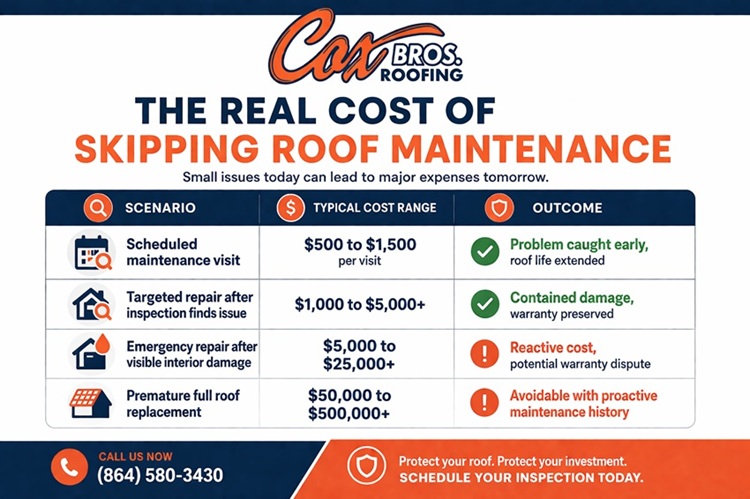
One thing worth knowing: most commercial roof warranties, whether manufacturer or workmanship, require documented maintenance to remain valid. A roof that has not been inspected regularly may have coverage that has lapsed without the building owner realizing it.
Situation 3: You Are Building, Expanding, or Re-Roofing
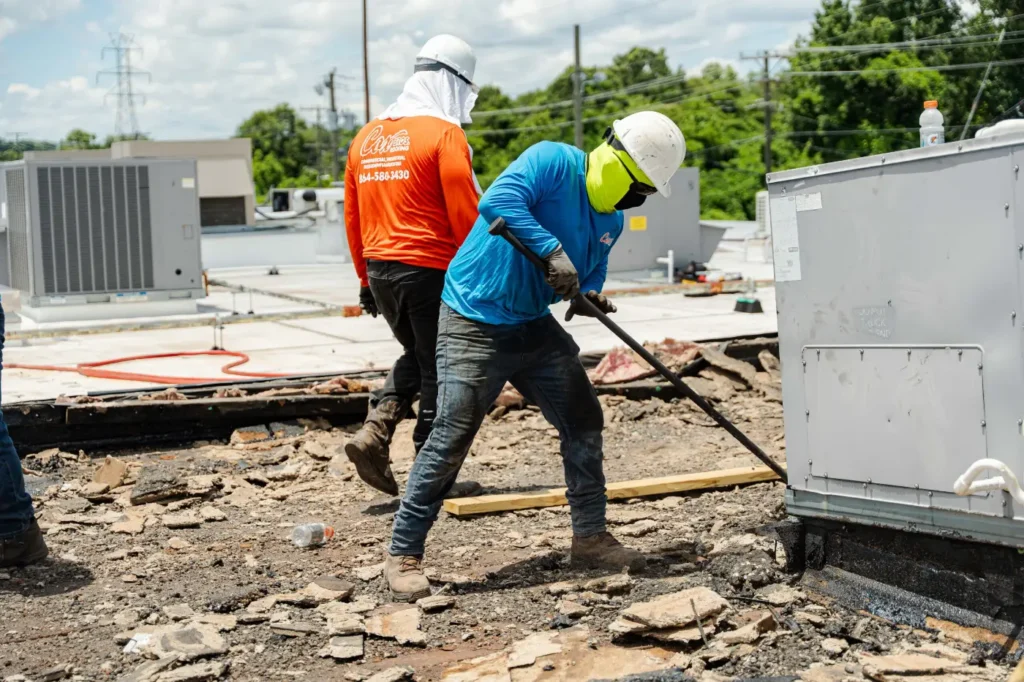
New construction, a full commercial roof replacement on an existing building, or a significant expansion that requires new roofing. This is where material selection and installation quality have the longest downstream effect.
The right system for a Greenville commercial property depends on the building type, the roof slope, the drainage layout, the building’s use, and how long the owner intends to hold the property.
How to Evaluate a Commercial Roofing Contractor in Greenville
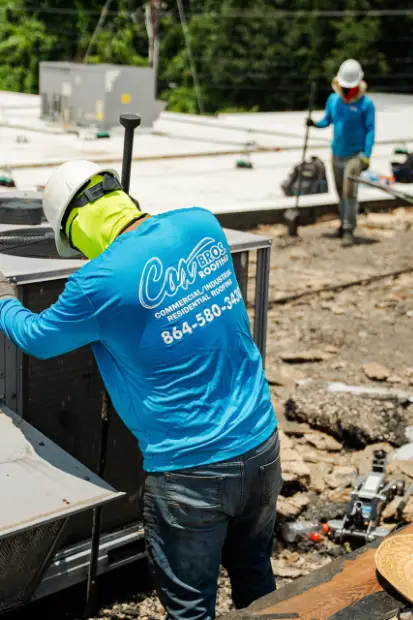
Greenville has added a significant amount of commercial square footage over the past several years. With that growth comes more roofing contractors in Greenville competing for the work, and not all of them bring the same level of accountability.
These are the things worth confirming before signing anything:
- Licensing. In South Carolina, roofing contractors performing work over $10,000 in value must hold a General Contractor license with a Roofing sub-classification through the SC Department of Labor, Licensing and Regulation. Verify the license is current and in good standing before any work begins.
- Insurance. General liability and workers’ compensation coverage should both be confirmed. Ask for certificates, not just verbal assurances. A contractor working on your property without proper coverage creates direct exposure for you.
- Written scope and warranty documentation. The contract should specify the materials by manufacturer and product line, the installation method, the project timeline, the warranty terms for both materials and labor, and the payment schedule. Vague scopes lead to disputes. Clear ones do not.
- References on comparable work. A contractor who has done residential work and wants to move into commercial is not the same as one with documented commercial experience. Ask specifically for references on commercial projects of similar size and system type.
What a Commercial Roof Maintenance Program Actually Includes
A maintenance program on a commercial roof is more than an annual inspection. Done correctly, it is a documented service history that catches developing problems before they are emergency repairs, extends the useful life of the system, and provides the paper trail that warranty claims require.
For most commercial flat and low-slope roofs, twice-annual inspections are standard. One inspection in spring before storm season starts, and one in fall after the worst of summer is past. In between, any significant weather event, such as a hurricane, warrants a walkover to check for debris accumulation, drainage blockages, and membrane impacts.
The Cost of Skipping Maintenance on a Greenville Commercial Property
Commercial roofs that fail early almost always have the same history: deferred inspections, minor repairs that were put off, and a drainage problem that sat unaddressed until the membrane gave up. The cost gap between catching a $400 seam repair and managing a $15,000 moisture intrusion project is real.
Greenville’s industrial market has been expanding steadily, with more warehouse and commercial space coming online across the county. Many of those buildings will eventually change hands or be re-leased. A documented maintenance history and a roof in good condition are assets. A deferred problem discovered during due diligence is not.
When Repair Is Not Enough: Knowing When to Replace
There is no universal rule for when a commercial roof crosses from repairable to replaceable. The decision depends on the extent of the damage, the system’s age relative to its expected lifespan, the condition of the underlying deck, and the cost of continued repairs versus the cost of starting fresh.
General signals that a replacement conversation is warranted:
- The system is within five years of the end of its expected service life and has required multiple repairs in recent years
- Core samples or an infrared inspection reveal widespread moisture in the insulation board, not just at one failure point
- The roof deck has structural damage that makes membrane repairs unreliable
- The repair cost for the current problem approaches or exceeds 25 to 30 percent of a replacement cost
The Value of Understanding Where Your Roof Stands
The common thread across inspections, maintenance, repairs, and replacement planning is information. Commercial property owners make better decisions when they understand the condition of their roof, the risks they are facing, and the options available to address them.
Not every roof needs a repair. Not every repair requires a replacement. Not every aging roof is at the end of its service life. The challenge is knowing which situation applies to your building before a small issue becomes a larger one.
For Greenville business owners and property managers, commercial roofing is ultimately about protecting the asset beneath it. The buildings that perform best over time are usually not the ones with the newest roofs. They are the ones where someone is paying attention long before a problem becomes urgent.
Protect Your Commercial Property
Contact Cox Bros Roofing for your commercial roof needs.